

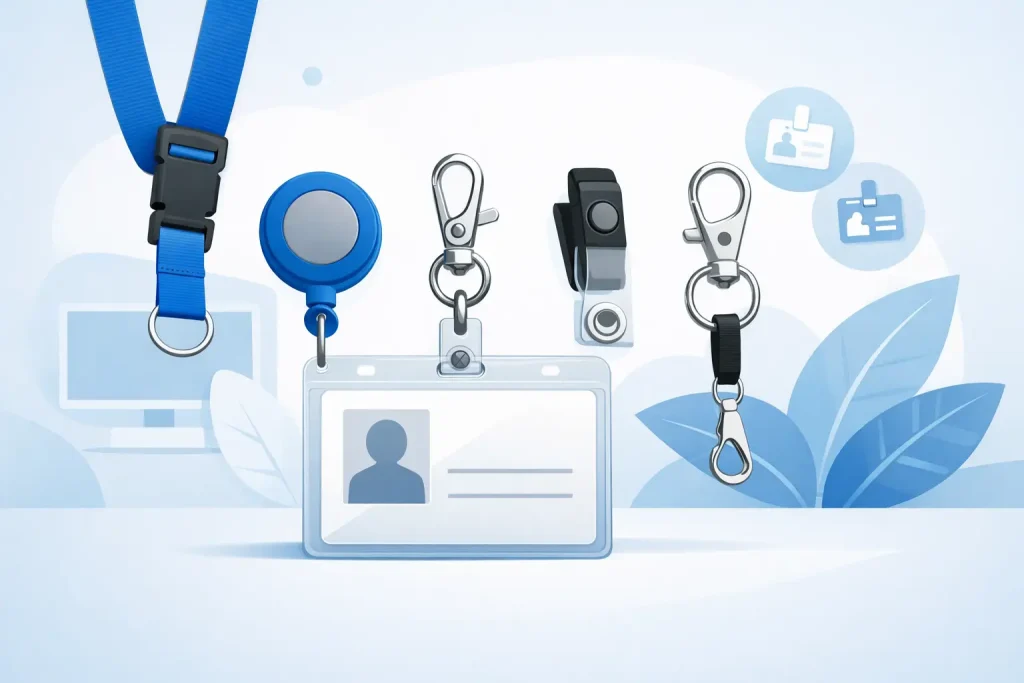
A badge setup usually fails at the attachment point, not the lanyard itself. If you are choosing the best lanyard attachments for badges, the right option comes down to how often badges are scanned, how securely they need to stay in place, and how much wear they will take across a day, a term or a full event schedule.
For procurement teams, event organisers, schools and workplaces, that choice affects more than convenience. It changes how quickly people move through entry points, how often badges get replaced, and how professional your branded setup looks on the day. A good attachment keeps things simple. A poor one creates queues, damaged cards and unnecessary reorders.
What makes the best lanyard attachments for badges?
The best attachment is the one that matches the job. That sounds obvious, but it is where many orders go wrong. A conference badge used for visual identification has different demands from a staff ID card tapped against a reader 30 times a day. A school visitor pass has different risks from a backstage event credential.
There are three practical factors to weigh up. First is security – how firmly the attachment holds the badge or holder. Second is usability – whether staff, students or attendees can present the badge quickly. Third is durability – whether the fitting will stand up to repeated use without twisting, snapping or loosening.
Brand presentation matters too. If you have invested in custom printed lanyards, exact PMS colour matching and branded card holders, the attachment should not look like an afterthought. A clean, reliable fitting helps the whole system look considered and well managed.
Swivel hooks are the standard for good reason
If you need a dependable all-rounder, swivel hooks are often the safest choice. They connect easily to most badge holders and allow the card to turn naturally, which reduces twisting in the lanyard. That makes them a strong fit for offices, conferences, schools and general visitor management.
The main advantage is flexibility. Users can move the badge into view without fighting the strap, and the hardware handles regular movement well. For organisations ordering in volume, swivel hooks also make sense because they suit a wide range of holder styles, so you are not locking yourself into a narrow setup.
Their limitation is access speed. If users need to tap a card against a reader frequently, a fixed holder on a swivel hook can still be slower than a retractable option. For visual ID, though, they are hard to fault.
Bulldog clips suit simple display applications
Bulldog clips work best when the badge only needs to be displayed, not scanned. They grip directly onto a card or holder and keep the setup straightforward. For short-term events, front-of-house visitors or temporary staff, that simplicity can be an advantage.
They are generally cost-effective and easy to distribute. If you are managing a large event and need a functional attachment that keeps the line moving at registration, bulldog clips can do the job.
The trade-off is security and card wear. A direct clip can mark printed stock if it is attached straight to the badge, and it is not always the best option for premium credentials or long-term use. If your cards are branded, re-used or printed on PVC for durability, it often makes more sense to pair the lanyard with a holder instead.
Trigger clips offer a stronger, more secure hold
For heavier holders, multi-card setups or environments where badges take more strain, trigger clips are worth considering. They are designed for a firmer connection and can cope better with pulling and repeated handling.
This makes them useful for warehouses, production sites, venues, sporting events and any operation where staff move around constantly. If a badge is carrying access credentials, ID and possibly a second insert, the extra strength is practical rather than cosmetic.
The only caution is bulk. Trigger clips are more substantial than lighter fittings, so they can feel more industrial. That is not a problem for many workplaces, but if you are aiming for a slim conference look, they may be more attachment than you need.
Retractable badge reels are best for frequent scanning
If users need to present a card over and over, retractable badge reels often outperform standard attachments. Instead of removing the badge or leaning awkwardly towards a reader, the user can extend the card and let it return into place. In offices, hospitals, schools and secure buildings, that saves time every day.
From an operations point of view, reels can reduce friction at access points. They also help protect cards from constant handling because the badge stays attached while being presented.
That said, reels are not the answer for every order. They add another component, which means another part to specify and another variable in the setup. They can also create more visual clutter if brand presentation needs to stay very clean. For high-use access cards, the convenience usually outweighs that. For one-day event passes, it may not.
Lobster clips and split ring options have niche uses
Lobster clips can work well when you want a neat attachment that opens and closes securely. They are commonly used where the holder already has a compatible slot or ring point. They feel tidy and can suit branded applications where presentation matters.
Split rings are better for permanent attachment than quick interchange. Once fitted, they hold firmly, but they are less convenient if cards need to be swapped between users or updated frequently. For fixed identification systems, they can be useful. For fast event issue desks, they are usually too slow.
Matching the attachment to the badge holder
Choosing the best lanyard attachments for badges is not just about the metal fitting. It is about how the attachment works with the badge holder or card format. A strong clip on the wrong holder still creates problems.
Soft plastic holders are popular for events and visitor passes because they are light and economical. They pair well with swivel hooks and lighter clip styles. Rigid holders suit cards that need better protection and are often a better match for stronger attachments like trigger clips. If cards are tapped regularly, combining a holder with a badge reel can improve usability without sacrificing protection.
This is also where ordering from one supplier can save time. When the lanyard, holder, card and attachment are being planned together, compatibility issues are easier to avoid before production starts.
How different organisations should choose
Event organisers usually need a balance of speed, cost and presentation. For most conferences and trade shows, swivel hooks with soft holders are a practical choice. They look professional, work across large volumes and keep registration simple.
Schools and universities often need more durability. Student and staff IDs are handled every day, so stronger fittings and protective holders usually pay off over time. If cards are used for access control or library functions, reels may make sense for staff even if they are unnecessary for students.
Corporate offices tend to split into two needs – visitor badges and employee access cards. Visitor passes can stay simple. Staff cards often benefit from a more functional setup, especially where secure access is involved.
Venues, festivals and clubs need to think about movement and replacement rates. If credentials are short-term but heavily used, stronger clip hardware can reduce failures during the event. If the item is more about visual control than scanning, a standard hook-and-holder combination is often enough.
Cost matters, but replacement cost matters more
It is tempting to choose the cheapest attachment across a bulk order, especially when quantities are high. But the better comparison is not unit price alone. It is unit price versus failure rate, replacement effort and day-of-event disruption.
A lower-cost fitting that breaks, twists or does not suit the holder can end up costing more in staff time and reprints. For businesses managing deadlines, that is not a small issue. The safer approach is to choose hardware that fits the actual use case, then align the rest of the specification around it.
This is where experienced guidance helps. A supplier that handles design, sampling and production together can spot mismatches early and help you choose an attachment that works in the real world, not just on a quote sheet.
The practical way to make the right choice
If the badge is mainly for display, start with a swivel hook. If it needs frequent scanning, look closely at badge reels. If the setup is heavier or the environment is tougher, move towards a trigger clip. If presentation is simple and short-term, bulldog clips may be enough.
That decision gets easier when you review the full badge system at once – lanyard width, branding, holder type, card stock, wear period and turnaround time. Lotsa Lanyards works with organisations that need that process handled properly, from design support through to delivery, so the finished product is ready for use rather than pieced together under pressure.
The best attachment is rarely the fanciest one. It is the one that keeps your people moving, your branding consistent and your order off your to-do list.