
When a school is ordering hundreds or thousands of ID items at once, small mistakes get expensive fast. Bulk school ID accessories are not just add-ons – they affect daily wear, card protection, staff visibility, student safety and how smoothly IDs are issued across the whole campus.
For school administrators, procurement teams and office staff, the real job is not finding the cheapest lanyard or holder. It is choosing a combination of products that will hold up in busy environments, match school branding, arrive on time and reduce replacement headaches over the term. That takes a practical buying approach, especially when multiple year levels, staff groups and visitor categories all need different ID setups.
What counts as bulk school ID accessories?
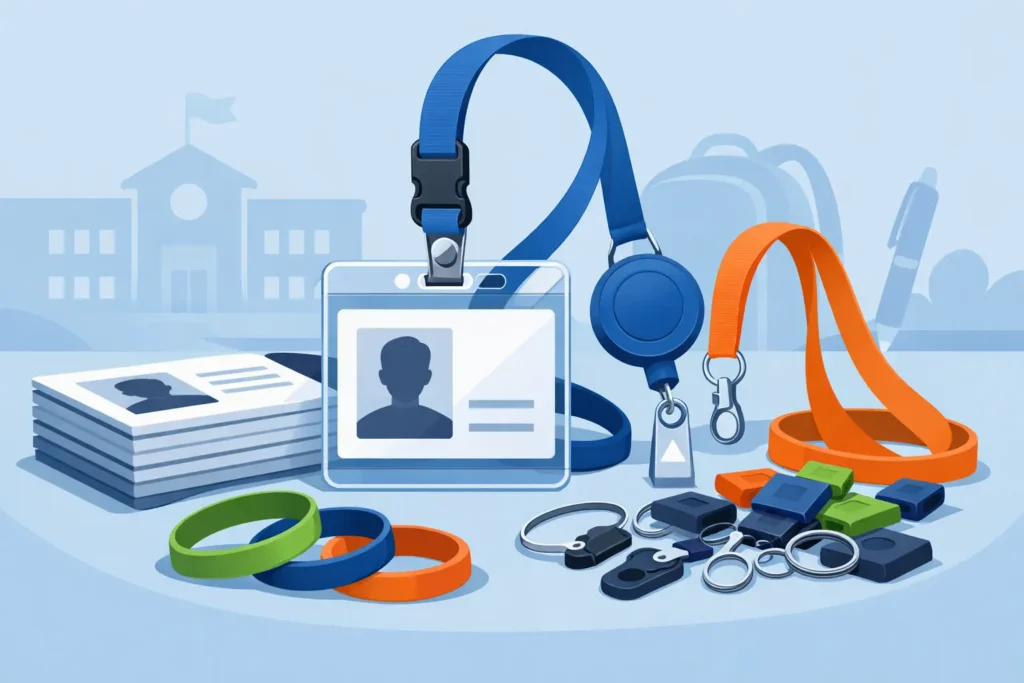
In most school settings, this category includes lanyards, card holders, badge reels, clips, PVC ID cards and sometimes wristbands for excursions, events or temporary access. Each product does a different job, and the right mix depends on how the school actually uses IDs day to day.
A primary school may prioritise breakaway safety lanyards and simple printed cards. A secondary college may need colour-coded holders for students, staff and contractors. A university or large independent campus might need a more layered setup, with photo IDs, durable holders, retractable reels for staff access and branded accessories that align with strict brand guidelines.
That is why bulk ordering works best when it is planned as a system, not as separate line items.
How to choose bulk school ID accessories
The first question is wear environment. IDs used in classrooms and administration areas face different conditions from IDs worn outdoors, in workshops, libraries, canteens or sport facilities. If cards are constantly being scanned, a rigid holder may protect the edges better than a soft sleeve. If staff need to tap in and out all day, a retractable reel may be more practical than asking them to remove a card from a holder every time.
The second question is replacement frequency. Schools with younger students often see higher loss and damage rates, so it can make sense to choose lower-cost accessories with straightforward reordering. For staff and senior students, a slightly more durable setup may reduce ongoing spend even if the unit price is higher at the start.
Branding matters too, but in a school environment it should support function. Clear colours can separate faculties, year levels or access permissions at a glance. Custom printing also helps present a more organised front to parents, visitors and the broader community. If exact school colours matter, it is worth asking whether PMS matching is available rather than settling for a close enough option.
Lanyards are usually the starting point
For many schools, the lanyard is the most visible part of the ID program. It carries the school name every day, so print quality and colour consistency matter. It also needs to be comfortable enough for regular wear and durable enough to survive lockers, bags, playgrounds and repeated washing of hands without looking tired after a few weeks.
Material choice makes a difference. A budget stock lanyard can work for temporary use, open days or short-run events. A custom printed lanyard is usually the better option for ongoing student and staff use, because branding is cleaner and colour control is stronger. If the school wants one supplier across multiple accessories, this also helps keep the look consistent.
Safety should not be treated as a side issue. Breakaway clips are often a sensible inclusion in school environments, especially for younger students or active settings. They may add a little to the unit cost, but they can be the right call where duty of care is a factor.
Card holders, reels and clips each solve a different problem
Schools sometimes default to one accessory for everyone, but that can create unnecessary frustration. The right holder depends on how the card is used.
Soft plastic holders are cost-effective and lightweight. They suit general display where cards do not need heavy protection. Rigid holders offer better defence against cracking, bending and edge wear, which can be useful when IDs are carried daily in crowded school environments. If the card includes a barcode or access feature, protecting print quality becomes even more important.
Badge reels are particularly useful for staff. Admin teams, teachers, librarians and maintenance staff may need to present or scan ID regularly, and a reel can be faster than unclipping or removing a card from a lanyard. Clips can also work well in some roles, though they are less ideal when a visible front-facing ID is required at all times.
This is where buying on price alone can backfire. The cheapest combination is not always the most practical, and impractical accessories usually create extra admin later.
Matching the accessories to the user group
A good school ID rollout usually separates products by user need. Students, staff, contractors and visitors rarely need the same setup.
Students often need something simple, comfortable and easy to replace. Staff may need higher durability and better access functionality. Visitors benefit from clear colour distinction and temporary holders that can be issued quickly at reception. Contractors and volunteers may need visible credentials that are easy for staff to identify from a distance.
This is also where colour coding becomes useful. A change in lanyard colour or holder style can support security without making the system hard to manage. The goal is quick visual recognition, not complexity for its own sake.
Why custom printing matters more than many schools expect
A plain accessory may look cheaper on paper, but custom printing can reduce confusion and improve consistency across campuses. A branded lanyard is harder to mix up with personal items. A holder printed or paired with school colours can help reinforce user categories. Even simple branding can make issued IDs feel more official, which often improves compliance.
For schools with strict identity guidelines, consistency is not negotiable. If the crest, colour palette and layout need to align with existing uniforms, signage or enrolment materials, the supplier needs to be able to reproduce those details accurately. That is not just a design preference. It affects stakeholder confidence and how professionally the school presents itself.
Turnaround times can make or break the order
Most school ID orders have a fixed deadline behind them – orientation, term start, staff onboarding, open day, a rebrand or a compliance update. Delays create immediate operational problems because students and staff still need to be identified from day one.
That makes supplier process just as important as product range. Design support, proofing, sampling and production management all affect whether the order lands when needed. If a school is coordinating cards, lanyards and holders together, using one supplier can reduce friction and cut the risk of mismatched delivery dates.
This is where an experienced production partner earns its keep. A team that manages artwork checks, pre-production samples and scheduling can save the school from chasing multiple vendors or fixing preventable errors after approval.
Common buying mistakes with bulk school ID accessories
The most common issue is underestimating usage conditions. Accessories that look fine in a catalogue may not cope with daily student wear. The next mistake is ignoring replacement planning. Ordering the exact quantity needed for day one often means paying more later for urgent top-up runs.
Another problem is treating all users the same. One-size-fits-all sounds efficient, but schools are not one-size-fits-all environments. Reception staff, grounds teams, casual teachers and Year 7 students do not interact with ID products in the same way.
There is also the branding issue. If custom products are ordered without checking school colours, logo usage or approval workflows, delays become much more likely. For larger schools and multi-campus groups, that can hold up the whole project.
What a better ordering process looks like
The strongest results usually come from a short planning stage before quoting. Confirm who needs IDs, how the cards will be used, what accessories each group requires and whether colour coding or custom branding is part of the brief. Then check quantities with a buffer for new starters, lost items and mid-year enrolments.
From there, the supplier should be able to guide product selection, confirm artwork requirements, provide proofs and keep the job moving to deadline. That is especially valuable for school teams who do not have time to manage production detail internally.
For Australian schools working to fixed calendars, reliable timing matters just as much as unit cost. A sharper price is only useful if the order arrives ready to issue.
Lotsa Lanyards supports this kind of end-to-end process across lanyards, cards, holders and related ID products, which can make bulk school ordering far easier to manage.
The right school ID setup is the one that keeps working after the first week – when students are back in routine, staff are moving across campus and the office is handling everything else at once.