

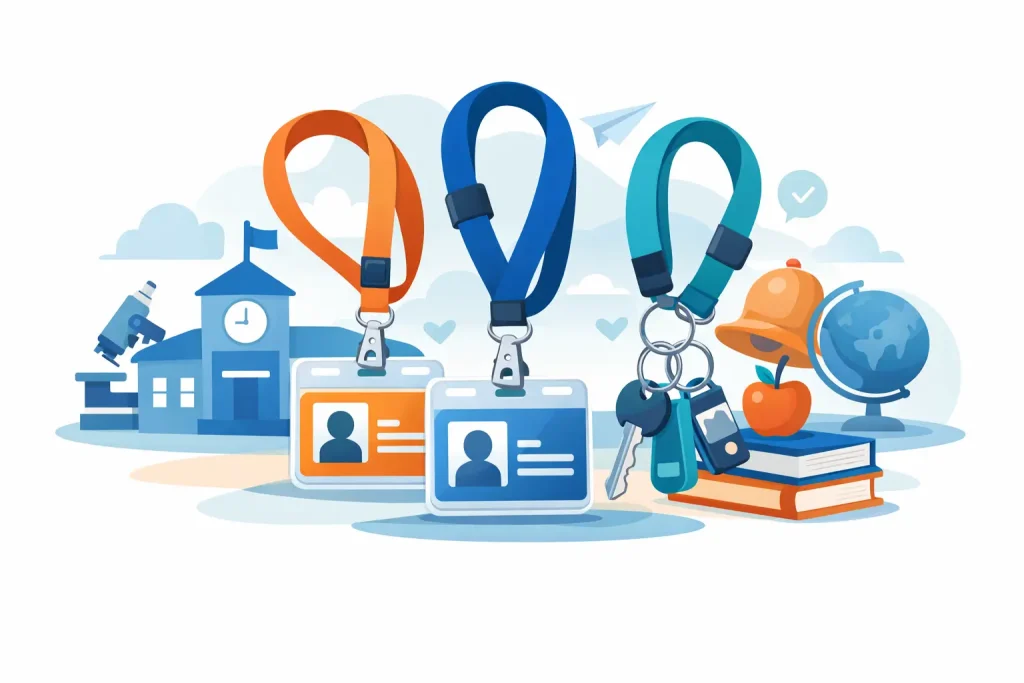
A staff badge that twists backwards, a visitor pass with no clear holder, a classroom key fob hanging from a frayed strap – these are small failures that create daily friction. Choosing the best lanyards for schools and staff is not just a branding decision. It affects identification, safeguarding, comfort, and how smoothly the site runs from the front office to the sports hall.
Schools and colleges usually need lanyards to do several jobs at once. They must identify staff clearly, stand up to constant wear, work with ID cards or keys, and support safeguarding policies without becoming a nuisance to wear all day. That is why the right choice is rarely the cheapest stock option on its own. The best result comes from matching the lanyard style, attachment and print method to how your site actually operates.
What makes the best lanyards for schools and staff?
In a school setting, practicality comes first. Staff are moving between classrooms, playgrounds, reception, meetings and duty points. A lanyard that looks good in a catalogue but feels heavy, flips constantly or catches awkwardly on clothing will quickly become a complaint.
Comfort matters more than many buyers expect. A soft polyester lanyard is often the safest all-round choice for daily wear because it balances durability with comfort and takes printed branding well. If your team wears lanyards for an entire day, strap width also matters. Narrower options can feel lighter, while wider lanyards can improve logo visibility and make staff IDs easier to spot from a distance. The trade-off is that a wider strap can feel bulkier for some users.
Durability is the next filter. Schools are hard-use environments. Lanyards get pulled, stuffed into drawers, worn outdoors and handled alongside keys, whistles and access cards. If they are carrying more than a lightweight plastic card, the attachment hardware needs proper attention. A standard J clip may be fine for simple ID display, but a trigger clip or split ring can be better where staff also need to carry keys or fobs.
Then there is visibility. Many schools use lanyards to distinguish staff, visitors, contractors, sixth form students or safeguarding roles. Clear colour coding can help reception teams and site staff identify who should be where at a glance. This is where custom printing adds real operational value. Exact brand colours, role labels and repeated logos can make the whole system clearer and more professional.
Safety features schools should not ignore
School buyers should always consider breakaway fittings. In many education settings, a safety breakaway is a sensible standard because it reduces risk if a lanyard is pulled or caught. That is especially relevant in primary schools, SEND environments, sports settings and any role involving close physical interaction with pupils.
A double-ended lanyard can also be useful where cards need to stay facing forward. Because the card holder attaches at two points rather than one, it is less likely to twist around during the day. This improves visibility for safeguarding and reception control, although it can cost more than a basic single-ended style.
Material choice can affect safety and comfort too. Smooth woven polyester is common for a reason – it is reliable, cost-effective and suitable for custom print runs. Tubular styles can feel softer in use and may suit teams wearing lanyards continuously, but they are not always the first choice when exact, high-impact branding is the top priority.
Choosing the right attachment for school use
The lanyard itself is only part of the system. The attachment point often decides whether the product works properly in daily use.
For schools issuing standard ID cards, a metal clip paired with a rigid or soft card holder is usually the cleanest option. It keeps names and photos visible and protects the card from damage. If your team also uses swipe access, consider how easily the card can be presented at doors. In some cases, adding a card reel makes more sense than relying on staff to unclip cards repeatedly.
For premises teams, PE staff or support teams carrying keys, a stronger fitting may be needed. Split rings and trigger clips give better support for heavier items, but they also add weight. That can make the lanyard less comfortable for all-day wear, so some schools choose separate solutions for different departments rather than trying to make one specification do everything.
This is often the smarter approach. The best lanyards for schools and staff are not always one universal product across the whole site. Teaching staff, office teams, visitors and maintenance personnel may each need a slightly different setup.
Printed vs stock lanyards
Stock tube lanyards have their place. They are quick, simple and often suitable for short-term use, open days, temporary staff or events where branding is less critical. If speed and budget are the only drivers, they can do the job.
For most schools, though, custom printed lanyards are the better long-term option. Repeated use means branding, colour coding and identification become part of the school’s operating system. A printed staff lanyard in school colours looks more professional, supports consistency across the site and makes replacement ordering easier later on.
Custom print also helps with role clarity. Some schools print the school name and logo only. Others add text such as STAFF, VISITOR or CONTRACTOR, or create separate colourways for different user groups. That can improve safeguarding processes, especially on larger campuses where reception cannot personally know every adult on site.
If brand compliance matters, colour matching should be discussed early. For schools with established branding guidelines, getting the printed shade right avoids the common problem of accessories looking close, but not quite correct. That detail matters when a school is trying to present a consistent identity across uniforms, signage, prospectuses and events.
Card holders and reels often matter as much as the lanyard
A good lanyard can still underperform if the card holder is wrong. Schools that issue photo IDs should think about card orientation, durability and day-to-day access needs.
Rigid card holders offer more protection and are useful where cards are handled frequently or need to stay neat. Soft plastic holders can be more flexible and economical, particularly for larger volumes. The better option depends on how often cards are removed, scanned or replaced.
Card reels are worth considering for staff who need to present access cards multiple times a day. They reduce wear on the lanyard clip and make door access more convenient. The trade-off is that they add another component, so quality matters. Cheap reels tend to fail early, which creates avoidable replacement costs.
Ordering for schools without creating extra admin
Procurement teams and school administrators are usually not looking for novelty. They want a product that arrives on time, matches the brief and does not create another round of corrections. That is why the ordering process matters almost as much as the product itself.
Before requesting a quote, it helps to confirm four things: who will wear the lanyards, what they need to carry, whether you need colour-coded groups, and whether the order is for day-to-day operations or a one-off event. That avoids over-specifying where a simple stock solution would work, or under-specifying where safeguarding and heavy use demand something better.
Sampling can also save time later. If your school is ordering in volume, checking a pre-production sample reduces the chance of issues with width, print clarity, attachment choice or colour match. For schools managing multiple branded items, working with one supplier for lanyards, ID cards, holders and related products can reduce internal handling and make reorders simpler. Lotsa Lanyards supports that kind of end-to-end process, from artwork support through to delivery, which is often the difference between a straightforward rollout and a drawn-out admin task.
When the cheapest option costs more
Low unit price can look attractive, especially for larger schools or trusts ordering in bulk. But if lanyards fray quickly, clips fail, colours are inconsistent or IDs are hard to read, the real cost shows up in replacements, staff irritation and weaker site presentation.
Better school lanyards do not need to be over-engineered. They just need to be fit for purpose. A well-made printed polyester lanyard with the right safety fitting and a suitable card holder will outperform a cheaper generic alternative in most daily school environments. That usually means better value over the full life of the order, not just on the initial quote.
If you are choosing for a primary school, lean towards comfort and safety. If you are buying for a secondary school or college, identification visibility and card access may matter more. If you are ordering for a multi-site trust, consistency across locations should be part of the decision from the start.
The right lanyard makes everyday identification easier, keeps branding consistent and removes one more point of friction from a busy school day. That is usually the best sign you have chosen well.