
If you are ordering branded lanyards for a conference, school, workplace or event, one practical question usually comes up early – can lanyards be printed both sides? The short answer is yes. Double-sided printing is available on many custom lanyard styles, and in the right setting it gives you better brand visibility, clearer messaging and a more polished result.
What matters is not just whether it can be done, but whether it is the right choice for your use case, artwork and budget. For buyers managing deadlines, approvals and bulk quantities, that distinction matters.
Can lanyards be printed both sides for all types?
Not every lanyard construction handles double-sided printing in exactly the same way. In most custom printed orders, both-side printing is possible, but the best result depends on the material, print method and the level of detail in your design.
Polyester printed lanyards are one of the most common options for double-sided artwork. They offer a reliable surface for logos, text and repeated branding, and they suit high-volume orders where consistency and cost control matter. If your team wants the same logo and message visible whichever way the lanyard twists, this is often the most straightforward solution.
Dye sublimated lanyards can also work well for both-side printing, especially when you need more detailed artwork, gradients or multiple colours. If strict brand matching matters, the production approach should be discussed before artwork is approved, particularly when exact PMS colours are part of the brief.
Woven and screen printed options may have more limitations depending on the design. That does not mean they cannot be used, but it does mean the artwork needs to suit the production method. Fine text, very small logos or different artwork on each side may not always be the best fit.
Why buyers choose double-sided lanyard printing
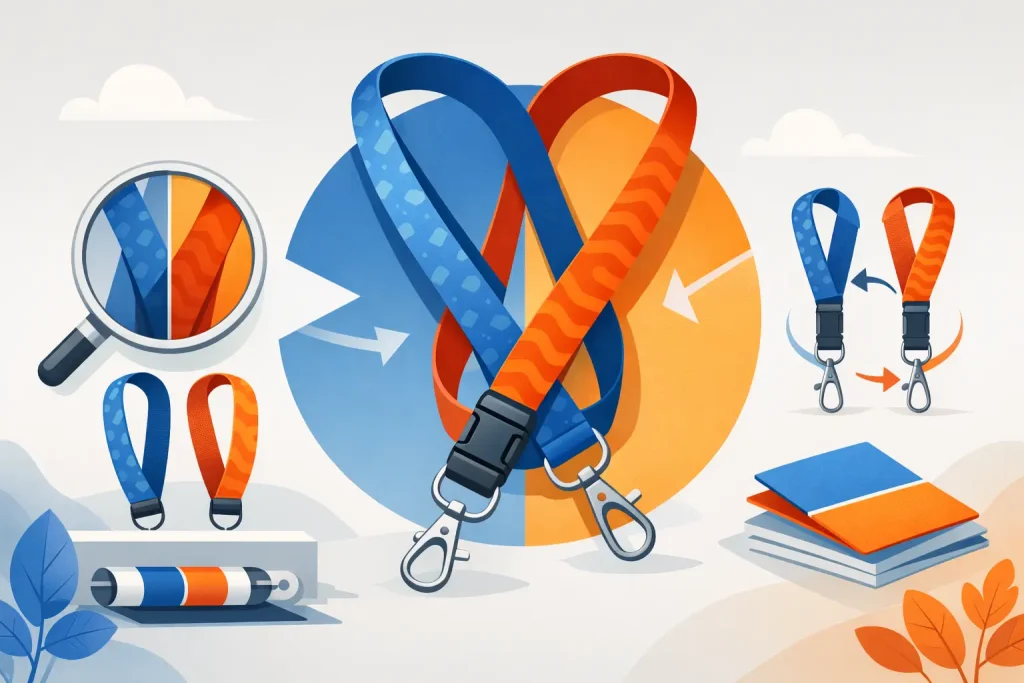
The biggest reason is simple – lanyards move. They twist when worn, especially during busy events, on factory floors, in schools and across large workplaces. If printing appears on one side only, your branding can disappear from view half the time.
Double-sided printing keeps the logo, colour and message visible from more angles. For event organisers, that helps with sponsor exposure and brand consistency across staff, exhibitors and attendees. For schools and workplaces, it makes identification look more professional and deliberate.
There is also a functional benefit. Some organisations use one side for branding and the other for practical information, such as a website address, department name, event title or safety wording. That can be useful when you want the lanyard to do more than just carry a card holder.
For procurement teams ordering in bulk, this often comes down to value rather than appearance alone. If the lanyard is part of a wider ID or access system, having both sides printed can make the product work harder without adding another item to the order.
When double-sided printing makes the most sense
If your lanyards will be worn in public-facing environments, both-side printing is usually worth serious consideration. Conferences, expos, education settings, healthcare environments, stadiums and visitor-heavy offices all benefit from better visibility.
It is also a strong option when your brand identity relies on a repeated logo pattern or a colour-critical presentation. If the lanyard is an extension of your broader branded materials, one-sided printing can sometimes look unfinished once the product is in use.
That said, it depends on the role of the lanyard. If it is being used mainly for short-term internal wear, or if budget is the main driver and branding is secondary, single-sided printing may still be the right fit. A good supplier should help you weigh that trade-off clearly rather than pushing unnecessary extras.
Same artwork on both sides or different artwork?
Both approaches are possible, and the right choice depends on how the lanyard will be used.
Printing the same design on both sides is the most common route. It gives a clean, consistent appearance and keeps the branding visible whichever way the strap sits. For most businesses, schools and event organisers, this is the safest and most effective option.
Using different artwork on each side can be useful when you want to combine branding with information. One side might carry the company logo, while the reverse includes a slogan, web address, event name or security message. This can be effective, but only if the design stays readable and uncluttered.
Trying to fit too much onto a narrow lanyard is where problems start. Text that looks clear on screen can become hard to read once reduced to print width, especially on thinner straps. If your aim is strong day-to-day visibility, simpler is usually better.
Design considerations before you approve artwork
Double-sided printing gives you more surface area, but it does not remove design constraints. Lanyards are still narrow products viewed at a distance and in motion. Good artwork needs to be built with that in mind.
Logo scale is one of the first decisions to get right. Oversized logos can feel cramped, while small logos may disappear once worn. Repeating artwork is often the best solution because it keeps branding visible along the full length.
Text should be brief and high contrast. If your brand palette uses subtle tonal differences, that may look great on other print items but weaker on fabric. This is where pre-production checks matter. A dependable supplier will flag readability issues before the job goes to print.
Colour accuracy is another practical factor. If you need exact corporate colours, mention that at quoting stage rather than after artwork is finalised. Consistent branding across lanyards, cards, holders and other event materials is much easier when colour requirements are set from the start.
Cost, lead time and production trade-offs
Double-sided printing usually costs more than single-sided printing, but the increase is often reasonable when measured against the improvement in visibility and finish. For large orders, the extra value can outweigh the added unit cost very quickly.
Lead times can also vary depending on the print method, quantity and whether the artwork differs on each side. If you are working to a firm event date, school intake deadline or staff onboarding schedule, raise timing early. Production planning is much easier when approvals and artwork sign-off are handled before the deadline becomes tight.
This is where experience matters. A supplier that manages design support, sampling and production in one workflow can remove a lot of internal back-and-forth. For busy admin teams and marketing coordinators, that saves time as much as money.
How to decide if both-side printing is right for your order
A simple test is to ask what happens when the lanyard flips over. If your branding disappears, your event name vanishes or the product suddenly looks plain, double-sided printing is probably the better choice.
If your lanyards are part of a broader branded pack, it is also worth thinking about consistency. A well-printed lanyard alongside matching cards, holders or wristbands creates a more organised impression. That matters at events, in schools and in workplaces where presentation reflects on the organisation.
For some buyers, the answer is still no. If the order is highly price-sensitive, needed fast, or used only for a limited internal purpose, single-sided printing may be enough. The best decision is the one that fits the actual job, not the one with the longest feature list.
At Lotsa Lanyards, we see this most often with customers who need lanyards to do two jobs at once – carry clear branding and stand up to real-world use. When the product will be worn all day, moved constantly and seen by large numbers of people, printing both sides is often the smarter investment.
Before you place an order, think about visibility, wear conditions, artwork complexity and deadline pressure together. The right lanyard is not just the one that looks good in a proof – it is the one that still does its job once it is around someone’s neck at 8 am and still working hard by the end of the day.