

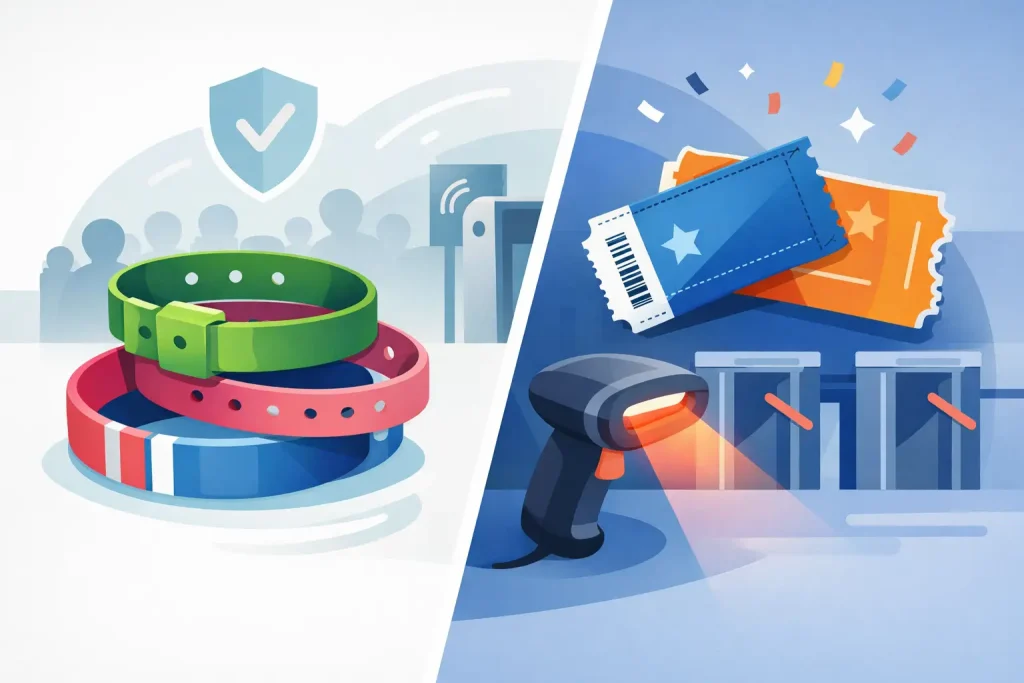
When the queue is backing up, staff are fielding questions and your event start time is already here, the choice between custom wristbands vs printed tickets for entry stops being a branding decision and becomes an operations decision. The right format can speed up access, reduce confusion and make life easier for your team. The wrong one can create bottlenecks, rechecks and avoidable cost.
For schools, festivals, corporate functions, fundraisers and venue operators, there is no single best option every time. It depends on how people arrive, how long they stay, how often access needs to be checked and what level of control you need once they are inside.
Custom wristbands vs printed tickets for entry: the practical difference
Printed tickets are familiar. They are straightforward to distribute, easy to post or hand out in advance and suitable when entry is checked once at the gate. If your event is simple – one session, one admission point, no re-entry – tickets often do the job well.
Custom wristbands work differently. They are worn, not carried, so they stay with the attendee throughout the event. That changes how security, re-entry and staff checking happen on the ground. Instead of repeatedly asking people to find a paper ticket or pass, your team can identify approved entry at a glance.
That visibility matters most in busy environments. A crowded school fete, licensed venue, multi-zone festival or sporting event puts pressure on front-of-house staff. Wristbands reduce handling and speed up visual checks, especially when different colours are used for different access levels, age groups or session times.
Where printed tickets make more sense
Printed tickets are often the better fit when your event has a defined start and finish and the ticket is mainly a proof of purchase. Theatre nights, one-off community events, raffles and seated functions can all work well with a printed format.
They also suit events where attendee data needs to sit directly on the item. Seat numbers, table allocations, event dates, barcode information or sponsor messaging are easy to include on a printed ticket. If your process involves scanning at one point and then no further access control, tickets can be efficient and cost-effective.
From a budget perspective, tickets can be attractive for short, simple events. They are easy to batch print, easy to sort and familiar to staff and guests. If there is no need for re-entry control or on-site identification, paying for a wearable product may not add enough operational value.
There is a trade-off, though. Tickets are easier to lose, damage or hand to someone else. Once attendees are inside, they are not always practical for repeated checks. Staff either stop people to ask for proof again, or they stop checking altogether.
Where custom wristbands pull ahead
Custom wristbands are strongest when entry control continues after the gate. If attendees move between zones, leave and re-enter, buy alcohol, access VIP areas or attend across multiple hours, a wearable pass is easier for everyone.
This is where speed becomes a real cost saver. Faster checks mean shorter queues, fewer disputes and less pressure on your event team. A wristband can be spotted from a distance. Staff do not need to inspect every pocket, handbag or mobile screen to confirm access.
Wristbands also help reduce transfer between attendees. Depending on the material and closure used, they are harder to remove and pass on than a printed ticket. That does not make them foolproof, but it does improve control compared with paper alone.
For brand-conscious organisations, wristbands offer another advantage. They are part access tool, part branded item. Colours can be matched to event branding, sponsor requirements or school house colours, and that consistency matters when presentation is part of the event experience.
Security and fraud prevention
If your main concern is unauthorised access, the better option usually comes down to how your event is managed in real life, not in theory.
Printed tickets can include numbering, perforation, unique artwork or barcode fields. These features help, but paper is still vulnerable to copying, swapping and accidental damage. A staff member under pressure may accept a creased or partially torn ticket simply to keep the line moving.
Custom wristbands add a physical layer of control. Distinct colours, custom print and single-use closures make it easier to identify valid attendees quickly. They are especially useful when security staff need to monitor movement throughout the venue rather than just at the entry point.
For higher-control environments, combining methods can be the smartest move. A printed ticket can handle pre-event sales and scanning, while a wristband is issued on arrival for on-site access. That approach adds a handling step at the gate, but for some events it gives the best balance of ticketing data and practical control.
Cost is not just the unit price
Procurement teams often start with unit cost, which is fair enough, but entry products should be judged on total event cost. A cheaper item that slows down access or increases staffing pressure can become the more expensive option.
Printed tickets may look better on paper for very short events, especially at scale. But if staff spend extra time checking re-entry, replacing lost tickets or sorting access disputes, those labour costs add up quickly.
Wristbands can deliver better value when they simplify the day. They cut repeat handling, support fast visual checks and reduce the chance of attendees being challenged multiple times. For larger or more complex events, that operational gain often justifies the spend.
Lead time matters too. If you are working to a fixed event date, reliable production and clear proofing are part of the buying decision. A product is only good value if it arrives on time, matches your branding and performs as expected on the day.
Branding, colour control and attendee experience
Entry products do more than control access. They also say something about how organised your event feels.
A printed ticket can carry event details, sponsor logos and promotional messaging, which is useful before the event begins. But once it is tucked into a pocket or discarded after scanning, its branding role is largely over.
A custom wristband stays visible. That makes it useful for branded events, school activities, fundraising days and festivals where colour and identity matter. If exact brand matching is important, having access to PMS-matched colours without added complexity can make approval easier for marketing teams and procurement alike.
There is also a practical attendee experience angle. People generally prefer not having to keep producing a paper ticket. A wristband is simpler, particularly for families, students or groups moving around a venue over several hours.
How to choose the right option for your event
Start with the entry process, not the product catalogue. Ask how many times access will be checked, whether re-entry is allowed and how quickly you need to move people through. Then look at whether you need one-time admission, all-day identification or multiple access levels.
If your event is single-session, low-risk and easy to supervise, printed tickets may be enough. If your event has multiple zones, repeat checks or a strong need for visual identification, custom wristbands are usually the safer operational choice.
If you need both data capture and strong on-site control, use both. Pre-sell with tickets, issue wristbands at the gate and keep the process simple for attendees once inside. That model works well for many schools, venues and event organisers because it balances administration with practical access control.
For buyers managing deadlines, artwork and approvals, supplier support also matters. A partner that can help with design, pre-production checks and fast turnaround reduces internal workload and lowers the risk of last-minute problems. That is often as valuable as the product itself.
The best entry solution is the one that holds up under pressure – at the gate, in the crowd and across the full event day. If you choose based on how your event actually runs, rather than what looks cheapest at first glance, you will usually make the right call.