
When a lanyard needs to carry a full-colour logo, gradients, fine text and exact brand shades without looking cheap after a week of wear, the dye sublimation lanyard printing process is usually the right place to start. For event teams, schools, HR departments and procurement staff, that matters because the print method affects not only appearance, but lead time, durability and how closely the finished lanyard matches approved artwork.
What the dye sublimation lanyard printing process actually does
Dye sublimation is a heat-transfer print method used to apply detailed artwork to polyester fabric. Instead of laying ink on top of the material, the process uses heat and pressure to turn dye into gas so it bonds into the fibres. That difference is the main reason sublimated lanyards can handle complex designs and still feel smooth to the touch.
For buyers, the practical result is straightforward. You get a lanyard that can reproduce photographic elements, multicolour logos, tonal backgrounds and crisp repeated branding far more cleanly than simpler print methods. It is especially useful when brand consistency matters and when a design includes more than one or two flat colours.
Why this process is widely used for custom lanyards
Many organisations order lanyards for conferences, staff IDs, visitor access, student identification or promotions. In those settings, the lanyard is handled constantly, seen up close and often worn for long periods. A fuzzy logo, poor colour match or rough print finish stands out immediately.
The dye sublimation lanyard printing process suits these jobs because it combines visual quality with practical wearability. The print becomes part of the fabric rather than sitting heavily on the surface, which helps the strap remain flexible and comfortable. It also performs well when designs run edge to edge or repeat along the full length of the lanyard.
That said, it is not automatically the best fit for every order. If you need a very specific woven texture or a raised print effect, another production method may suit better. The right choice depends on artwork, budget, quantity and deadline.
How the dye sublimation lanyard printing process works
1. Artwork setup and approval
The job begins with artwork. This is where many quality issues are either prevented or introduced. Logos need to be supplied clearly, colours need to be referenced correctly and the layout must be adjusted to the lanyard width, attachment area and repeat pattern.
A good supplier will check whether small text is readable, whether key elements sit too close to clips or safety breaks, and whether the design will still work once folded and assembled. For organisations with strict brand standards, this stage is also where PMS matching expectations are discussed. Not every print method handles colour the same way, so pre-production checks matter.
2. Printing onto transfer paper
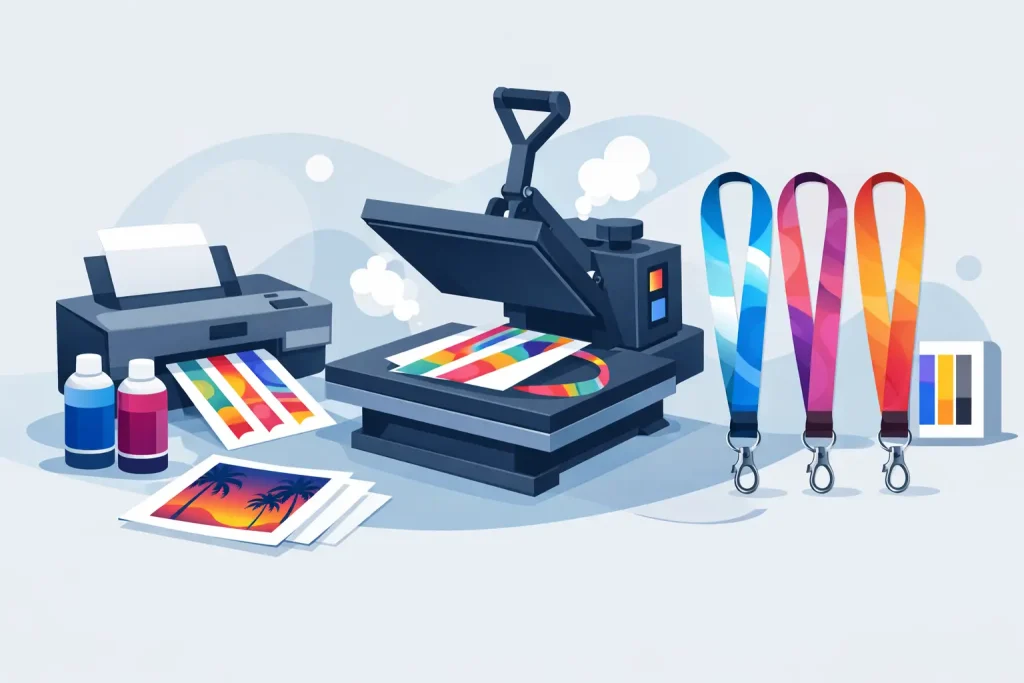
Once artwork is approved, the design is printed in reverse onto specialist transfer paper using sublimation inks. This is not the final lanyard material yet. The transfer sheet acts as the carrier that will move the design into the polyester webbing during heat pressing.
Print accuracy at this stage is critical. If colours are off here, they will be off on the finished product as well. Experienced production teams account for how dyes behave under heat so the final output is as close as possible to the approved design.
3. Heat transfer onto polyester material
The printed transfer paper is placed against white polyester lanyard material and fed through a heat press or calendar press. Under controlled heat and pressure, the dye converts into gas and penetrates the fibres. This is the key stage in the dye sublimation lanyard printing process.
Because the dye enters the fabric, the result is durable and smooth rather than thick or rubbery. It also allows for sharper detail across long runs of repeated branding. Timing and temperature control matter here. Too much heat can distort colour or fabric. Too little can reduce transfer quality.
4. Cutting, sewing and fitting attachments
After printing, the material is cut to size and assembled into finished lanyards. This includes adding clips, swivel hooks, bulldog clips, split rings, breakaway safety fittings or buckle releases, depending on the job.
This finishing stage affects usability just as much as print quality. A conference organiser may want a detachable buckle for quick badge scanning. A school may need safety breaks. Corporate staff lanyards may require a more polished clip style to suit ID cards and holders. The best print result still needs the right hardware to make the product practical.
5. Quality checks and dispatch
Before dispatch, finished lanyards should be checked for print consistency, assembly quality, colour accuracy and count. This part is easy to overlook when buyers compare prices, but it is often where dependable suppliers separate themselves from low-cost brokers.
For time-sensitive orders, quality control is not just about avoiding defects. It is about making sure the cartons that arrive are usable immediately, with no sorting, rework or last-minute damage control on your side.
Where dye sublimation performs best
Sublimation is a strong option when artwork includes multiple colours, gradients, fine detail or photographic elements. It is also well suited to campaigns where brand identity needs to stay consistent across lanyards, PVC cards, holders and related event materials.
If your logo uses exact corporate shades, it helps to work with a supplier that understands colour management and pre-production proofing. Close matching is achievable, but expectations should be set properly from the start because fabric, heat and ink behaviour can all influence the final appearance slightly.
For bulk orders, sublimation is also efficient once artwork is approved. That can be useful for businesses planning trade shows, universities preparing student intake packs or venues managing event access at scale.
Common buyer questions before ordering
One of the most common questions is whether sublimated lanyards fade quickly. In normal use, they hold colour well because the dye is embedded into the fabric rather than printed heavily on top. Heavy abrasion, harsh chemicals and prolonged UV exposure can still affect any printed product, but for most office, event and education settings, performance is reliable.
Another question is whether both sides can be printed. Yes, but it depends on the product specification. Single-sided and double-sided options may have different costs and production timings, so this should be confirmed at quote stage.
Lead time is the next issue. Production speed depends on quantity, attachment choice, artwork complexity and whether a sample is required before the full run. If the order is tied to an event date, it is worth flagging that immediately. A supplier with in-house workflow control and clear deadline management can save a lot of stress.
What to look for in a supplier
The process itself matters, but so does who manages it. Buyers often focus first on unit price, then discover too late that the order needed design support, colour guidance, attachment advice or better dispatch planning.
A reliable supplier should be able to help with artwork setup, explain any limitations before production starts and give a realistic turnaround rather than an optimistic one. That is particularly valuable for schools, corporate events and large staff rollouts, where delays create operational problems rather than minor inconvenience.
It also helps to work with a supplier that can handle adjacent items in the same order. If you are ordering lanyards alongside ID cards, holders, reels or wristbands, dealing with one production partner reduces admin and helps keep branding aligned. That is one reason many organisations choose specialists such as Lotsa Lanyards rather than splitting work across multiple vendors.
When another method may be better
Sublimation is versatile, but there are cases where a different production method makes more sense. A woven lanyard may suit a simpler design where texture is part of the look. A screen-printed option may work for a basic one-colour logo on a tighter budget.
This is where good advice matters. The best answer is not always the most expensive method or the one with the broadest design capability. It is the method that matches your artwork, use case and deadline without adding unnecessary cost.
If your design includes intricate colour transitions or brand-critical detail, sublimation is usually the stronger option. If the artwork is very simple and price sensitivity is high, there may be another route worth considering.
The right lanyard starts with the right print process, but the order only runs smoothly when artwork, finishing and delivery are handled properly from the start. If you are buying for an event, workplace or school rollout, asking the right questions early will usually save more time than chasing the lowest unit price at the end.