

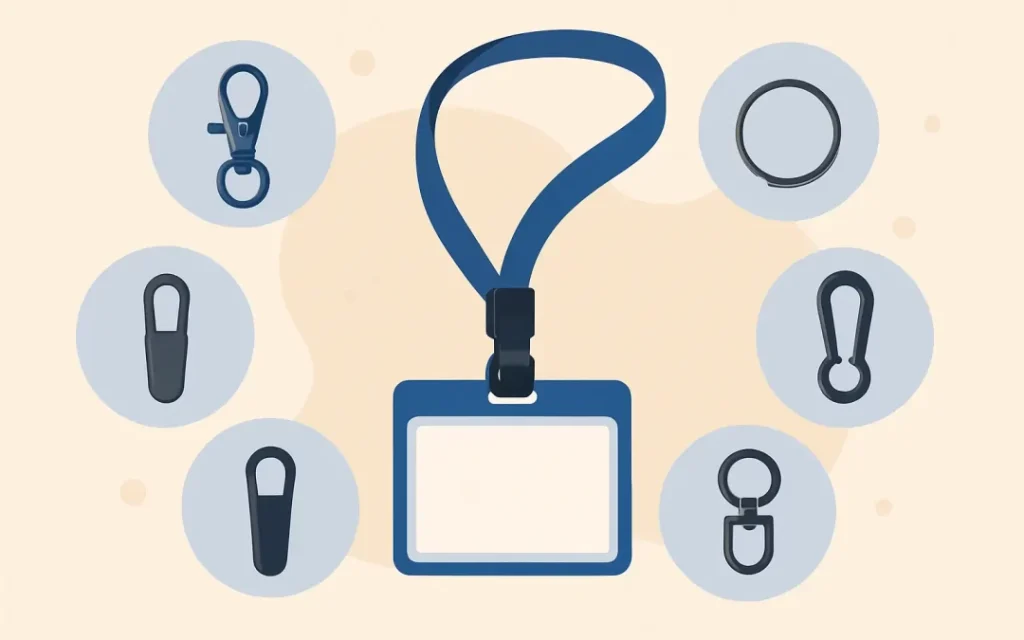
A lanyard can be perfectly printed, perfectly colour matched, and delivered on time – then let you down at the last moment because the clip is wrong. It twists. It snaps. It won’t fit the badge holder you already have in stores. Or it looks a bit too lightweight next to an otherwise professional uniform.
For organisations ordering in bulk, lanyard clips and attachments are not a minor add-on. They affect day-to-day usability, safety compliance, replacement rates, and even how “finished” your branding looks at check-in desks, reception counters, school gates, and exhibition halls.
What lanyard clips and attachments actually do
Think of the lanyard as the branded strap and the attachment as the working end. The attachment decides what the lanyard can carry (ID cards, badge holders, keys, whistles, USBs), how quickly it can be removed, and how much movement it allows before it starts to spin or tangle.
It also determines how the lanyard behaves under stress. That matters for schools and workplaces with safety policies, for venues with high footfall, and for events where thousands of people will be wearing lanyards for long days.
Start with the item you’re attaching
The fastest way to pick the right option is to work backwards from what’s going on the end.
If you’re attaching a card holder with a punched slot, you need a clip that can hook cleanly through the slot without forcing or bending it. If you’re attaching keys, you’ll want a closed loop or split ring so the keys can’t slip off when someone is rushing between meetings. If you’re attaching an access card that’s tapped dozens of times a day, you’ll want an attachment that rotates freely so the card presents the right way without the strap twisting itself into a knot.
This is also where materials matter. A rigid PVC card in a holder behaves differently to a soft wallet-style holder. A large name badge has more leverage and can pull at the clip. A heavy key set will quickly reveal whether you’ve chosen something light-duty.
Trigger clips: the everyday workhorse
Trigger clips are popular because they’re quick, familiar, and work with most slotted holders. You press the lever, the gate opens, and you attach.
They’re a reliable choice for conferences, visitor passes, staff IDs, and schools, especially when you need to minimise “how do I use this?” questions at distribution points.
The trade-off is that not all trigger clips are equal. The spring strength, the thickness of the metal, and the quality of the plating affect how they hold up over time. For long-term staff use, it’s worth specifying a sturdier option rather than treating it as a commodity part.
Swivel hooks and rotation: when twist becomes a problem
If you’ve ever watched a queue at a turnstile, you’ll know how often people flip and re-flip a badge to scan it. A swivel attachment helps the badge rotate without dragging the strap with it.
Swivel hooks are a strong fit for access control cards, especially in workplaces, universities, gyms, and venues where the card is constantly presented. You’ll typically see fewer twisted lanyards and less wear on the fabric near the join.
The nuance here is movement versus stability. More rotation can mean the badge sits less predictably on the chest. If your priority is presentation for front-of-house staff, you might prefer a more controlled attachment or pair a swivel with a holder style that keeps the card aligned.
Lobster clasps: neat finish, secure feel
Lobster clasps have a slightly more premium, “closed” feel than basic hooks. They’re secure for slotted holders and popular for branded corporate packs where you want the hardware to look deliberate rather than purely functional.
They’re also helpful when the lanyard might catch or snag, because the clasp is less likely to pop off compared to an open-ended hook.
The trade-off is speed. Lobster clasps can be a touch slower to attach when you’re prepping hundreds of lanyards for an event, and they can be less forgiving with thicker holder slots.
Split rings and key rings: for keys and equipment
If the lanyard is carrying keys, whistles, small tools, or fobs that must not detach, a split ring (like a standard key ring) is the sensible option.
This is common for facilities teams, caretakers, club staff, and organisers managing equipment cupboards or access gates. It’s also practical for wrist lanyards used with keys.
Be aware of day-to-day convenience. A split ring is secure, but it’s not fast when staff need to swap keys or move a fob between sets. If swapping is frequent, you may want a clip plus ring combination so the keys can be unclipped from the lanyard while staying on the ring.
Buckles and quick-release options: speed and policy
Quick-release buckles allow the bottom section of the lanyard to detach while the strap stays around the neck. This is useful when staff need to hand over a card, scan it against a reader, or present ID to security without removing the lanyard entirely.
It can also support hygiene and workflow in healthcare, laboratories, and busy venues – anywhere the lanyard is handled repeatedly.
The “it depends” is strength and behaviour under pull. A buckle that releases too easily can become annoying and lead to lost cards. A buckle that is too stiff defeats the point. If you have a policy requirement (for example, breakaway functionality), clarify whether the break happens at the neck clip, the buckle, or both.
Breakaway safety: schools, warehouses, and duty of care
If you’re ordering for children, busy education environments, or workplaces with moving machinery, breakaway safety clips are often non-negotiable.
A breakaway clip is designed to separate under strain to reduce choking risk. That’s important, but it should be chosen with clear expectations. Some organisations want a firmer breakaway so it doesn’t release during normal wear. Others prefer a lighter release for younger students.
If you’re issuing lanyards for events with mixed audiences, it’s worth thinking about where the lanyards will be worn and what activities people will be doing, not just what looks best at registration.
Two-clip and double-ended attachments: stability for wider badges
For landscape badges, larger credentials, or passes that must face forward (think steward badges, VIP passes, or multi-day festival credentials), double-ended attachments help keep the holder flat.
They distribute weight, reduce spinning, and look tidier on staff uniforms and sponsor lanyards.
The trade-off is cost and setup time. Two clips mean more hardware and slightly more assembly when you’re preparing packs. For high-profile staff or longer wear periods, the stability often pays for itself in fewer complaints and fewer replacements.
Quality signals buyers can specify (without over-engineering)
If you’re procuring for a team, a school, or a multi-site organisation, it helps to specify a few practical quality points rather than leaving “standard clip” open to interpretation.
Pay attention to how the clip is joined to the strap (crimp strength and finish), whether the metal edges are smooth (important for uniforms and comfort), and whether the plating matches the look you want (silver, black, or a specific finish). If the lanyards will be used outdoors or in humid settings, corrosion resistance matters more than it does for a one-day conference.
And if your branding is tightly controlled, remember that the hardware becomes part of the overall visual. A sharp print with a tired-looking clip is an avoidable mismatch.
Matching the attachment to your badge holders and reels
Attachments don’t live in isolation. They need to work with card holders, rigid or soft sleeves, and sometimes a retractable reel.
If you’re using card reels for frequent scanning, you’ll often want a clip that doesn’t fight the reel’s own swivel. If you’re using rigid holders, confirm the slot size and whether the holder is designed for a single clip or two points of contact. If you’re issuing PVC cards, consider whether they’ll be used in a holder at all or whether a slot punch is planned.
This is where a single supplier can remove friction. When the lanyards, holders, and cards are specified together, you reduce the risk of “almost fits” compatibility issues showing up a week before a deadline. If you need that kind of end-to-end support, Lotsa Lanyards can quote lanyards alongside holders, reels, wristbands, and card products so the full setup works as one.
How to choose quickly: three real-world scenarios
If you’re running a high-volume event where speed matters, prioritise a familiar, easy-to-attach clip and consider swivel functionality if badges will be scanned frequently. Your biggest enemy is slow distribution and tangled straps when staff are under pressure.
If you’re issuing staff IDs for everyday wear, choose for durability and comfort first. A slightly better clip is usually cheaper than replacing broken ones, reprinting cards, and dealing with the knock-on admin.
If you’re ordering for schools or youth groups, start with breakaway safety and then choose the simplest attachment that suits the holder. The best option is the one that meets policy and gets used correctly without constant supervision.
A helpful closing thought: when you’re approving artwork and confirming quantities, spend the extra minute on the attachment choice too – it’s the small component that decides whether your lanyards feel effortless or end up as a daily irritation.