

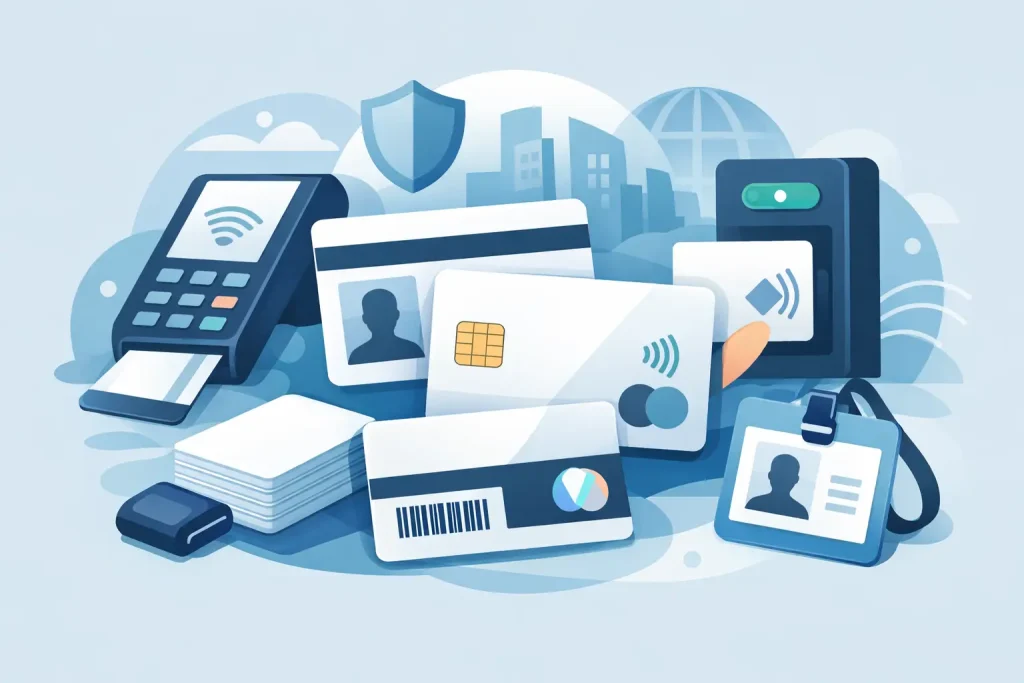
If you are ordering staff IDs, event passes or membership cards, one question usually comes up early – what are PVC cards, exactly, and why are they the standard choice for so many organisations? The short answer is that PVC cards are durable plastic cards made from polyvinyl chloride, sized and finished to handle regular use while carrying printed branding, names, barcodes, photos or access data.
That matters because a card is rarely just a card. For a school, it might need to identify students clearly every day. For a conference organiser, it may need to support fast check-in and match strict brand colours. For a business, it can sit at the centre of staff identification, visitor control and site security. When cards are ordered well, they reduce admin pressure, present the brand properly and hold up under real-world handling.
What are PVC cards made from?
PVC stands for polyvinyl chloride, a widely used plastic known for strength, printability and cost-effectiveness. In card production, it is typically formed into thin, rigid sheets that can be printed, laminated and cut into a standard card format. That familiar bank-card style size works because it is easy to carry, fits common holders and pairs neatly with lanyards, reels and clips.
Compared with paper or laminated cardboard passes, PVC gives you a more professional finish and a much longer usable life. It resists bending better, handles moisture more reliably and keeps print quality looking sharper over time. For organisations issuing cards in volume, that durability can mean fewer replacements and a more consistent appearance across the team.
What are PVC cards used for?
PVC cards are used anywhere identification, access or brand presentation needs to be clear and durable. The most common use is ID cards for staff, students, contractors and visitors. They are also widely used for membership cards, loyalty cards, gift cards, event credentials, club cards and temporary or ongoing access control.
In practice, the application affects the spec. A visitor card for a single-day event may prioritise bright branding, fast production and easy visual checking. A staff access card for an office or warehouse may need encoded data, a scannable barcode or a slot so it works neatly with a lanyard. A school card may need a student photo, year level and house colour. The material stays broadly the same, but the build and finish are chosen around how the card will be used.
Why PVC cards are so common
There is a reason PVC remains the go-to choice for organisations ordering printed cards in bulk. It offers a strong balance of durability, print quality and value. That combination is hard to beat when you need cards that look professional, survive daily use and stay within budget.
Print quality is a major factor. PVC cards can be produced with sharp logos, clean text, full-colour artwork and variable data such as names or ID numbers. If your organisation needs brand consistency, this matters. Colours need to be dependable across batches, especially when cards sit alongside branded lanyards, wristbands or other event and identity products.
The other advantage is versatility. A PVC card can be simple and visual, or it can include functional features that support operations. That flexibility makes it suitable for everything from a local club membership card to a corporate access pass.
Common features on PVC cards
Most PVC cards are customised to suit a specific operational need. Some are straightforward printed cards with names, logos and photos. Others carry more technical elements to support scanning, tracking or access.
You will often see PVC cards produced with photo ID, signature panels, barcodes, QR codes, magnetic stripes, numbering or writable areas. Cards can also be finished with gloss or matte lamination, depending on the look required and how much glare you want to avoid. Matte can be a practical choice for cards that are scanned under bright lights or checked by security staff, while gloss tends to deliver a sharper, more polished visual finish.
Slot punching is another common detail. If cards will be worn on a lanyard or attached to a reel, the slot position and reinforcement matter. This is one of those practical points that can be missed early and create headaches later. A good card supplier should help flag those details before production starts.
Printed cards versus encoded cards
Not every PVC card needs smart functionality. Many businesses only require visual identification, which keeps the process simpler and the cost lower. If a card only needs to display a person’s name, role, organisation and photo, a printed PVC format is usually enough.
If the card must open doors, log attendance or work with an existing access system, encoded or integrated technology may be required. That changes both the production method and the approval process. In those cases, getting the technical specification right at quote stage is critical because reprints caused by incompatible encoding can slow rollout and add avoidable cost.
What to consider before ordering PVC cards
For procurement teams, event planners and administrators, the best PVC card order starts with a clear use case. Who will carry the card, how often will it be used, and what does it need to do? Those three questions usually shape the material thickness, print method, finish and any variable data.
Brand control is another major factor. If your organisation works to strict identity guidelines, ask how colours will be matched and whether proofs or pre-production samples are available. This is especially relevant when cards need to align with lanyards, holders or wider event materials. Small variations can be noticeable when products are used side by side.
Turnaround time also deserves attention early. Card projects often sit close to event dates, onboarding deadlines or term starts, so artwork approval and data accuracy matter just as much as manufacturing speed. The smoothest jobs happen when the supplier manages the process end to end, from artwork setup through to production and delivery, rather than leaving the client to coordinate multiple steps.
Thickness, finish and lifespan
PVC cards are not all identical in feel. Thickness affects both perceived quality and durability. A thicker card usually feels more substantial and may last longer in high-use environments, but it can also increase cost slightly. For short-term events, a standard spec is often enough. For daily staff use, a heavier-duty option can make sense.
Finish changes usability as well as appearance. Gloss looks crisp and vibrant, but matte may be the better choice where legibility and reduced glare are priorities. If staff will be scanned quickly at gates or checked outdoors, those practical details count.
Are PVC cards right for every job?
Usually, but not always. PVC cards are a strong fit for most ID, membership and event applications because they are reliable, cost-effective and easy to customise. Still, there are trade-offs.
If the project is extremely short term and budget is the only driver, a simpler paper-based pass may be considered. On the other hand, if the card needs advanced chip technology or specialised security layers, the specification becomes more complex than a standard printed PVC job. The right choice depends on usage, lifespan, security needs and quantity.
Environmental considerations can also be part of the decision. Some organisations want to reduce single-use materials or look at how cards fit into broader sustainability goals. That does not automatically rule out PVC, but it does mean the ordering process should consider quantities carefully and avoid overproduction where possible.
What are PVC cards worth to your operation?
The real value of PVC cards is not just that they look professional. It is that they help organisations run more smoothly. They speed up identification, support access control, reinforce branding and give staff, students, members or attendees something durable enough to keep using.
For buyers managing multiple moving parts, reliability matters just as much as print quality. Clear proofs, accurate data handling, dependable colour matching and on-time delivery can make the difference between a straightforward rollout and a last-minute scramble. That is why many organisations treat cards as part of a wider identity system rather than a standalone print item.
When paired with holders, reels or custom lanyards, PVC cards become even more practical. They are easier to wear, harder to lose and more visible in busy environments. For schools, events, workplaces and venues, that joined-up approach usually saves time and presents a more polished result.
If you are planning an order, the smart move is to start with the job the card needs to do, not just the card itself. Once that is clear, the right spec is usually straightforward – and the result works harder from day one.