
When staff keep tapping into doors, scanning IDs, carrying keys and moving between customer-facing areas, the attachment at the end of the lanyard matters more than most buyers expect. The best lanyard attachments for staff are the ones that match the job, the security level and the way people actually work – not just the cheapest clip in the catalogue.
A poor attachment choice creates small problems that add up fast. Cards twist backwards, keys pull too heavily, holders snap off, or staff stop wearing the lanyard properly because it is awkward. If you are ordering for an office, school, healthcare setting, warehouse, venue or event team, the right attachment improves access, comfort and lifespan without adding complexity to the rollout.
How to choose the best lanyard attachments for staff
Start with function before appearance. If staff only need to display a photo ID, a standard attachment may be enough. If they need to tap in and out all day, open cupboards, carry whistles, radios or USBs, the attachment needs to handle repeated use and extra weight.
Security is the next factor. Some workplaces want a simple visible ID solution. Others need cards to stay attached at all times, with less chance of accidental removal or swapping. In those cases, the attachment and the card holder need to be considered together.
Then there is safety. In schools, healthcare, manufacturing, warehousing and active customer service roles, a breakaway option can be the better fit. It reduces the risk of the lanyard catching or being pulled. That does not mean every staff lanyard needs one, but it is worth assessing by role rather than applying one rule across the whole order.
Finally, think about durability and speed of use. Procurement teams often focus on unit price, but replacement costs and staff frustration can outweigh a small upfront saving. A dependable attachment that works every day usually delivers better value than the lowest-cost option.
The best lanyard attachments for staff by use case
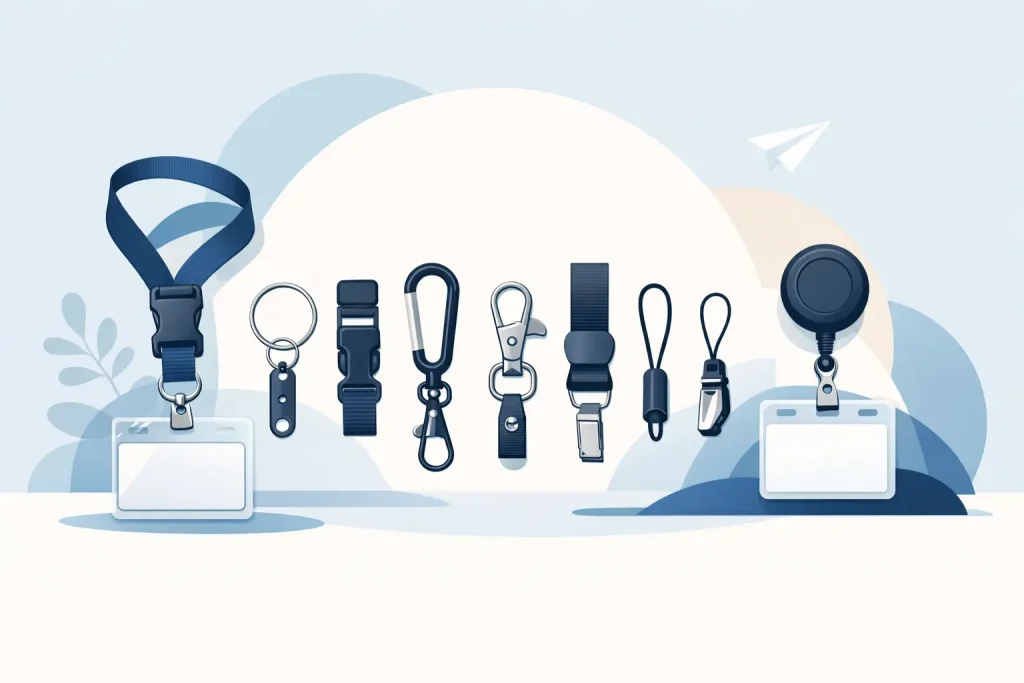
Swivel hook
For many workplaces, the swivel hook is the safest all-round choice. It clips easily onto card holders, keys or lightweight accessories, and the swivel function helps prevent twisting. That matters when staff are constantly turning the card around to scan or show it.
This attachment suits offices, schools, events and general workplace IDs. It is simple, familiar and reliable. If you need one attachment style for a mixed staff group, this is often where to start.
The trade-off is that it is not the most secure option for applications where cards must stay permanently connected. It is excellent for convenience, but less suited to higher-control environments.
Bulldog clip
A bulldog clip works well when staff need a card displayed flat and visible. It grips directly onto a PVC card or holder, making it useful for visitor passes, temporary teams and conference staff where presentation matters.
This can be a cost-effective choice for short-term use, but it depends on the card format. If the card or holder is handled constantly, the grip can be less convenient than a hook-based setup. It is practical, though not always the best long-term option for heavy daily access use.
Lobster clip
The lobster clip gives a more enclosed fastening point than a standard hook. That added closure makes it a good option when staff carry keys, small tools or accessories that should not slip free easily.
For facilities staff, maintenance teams or supervisors carrying more than an ID card, it can be a stronger everyday option. The downside is speed. It takes a little more effort to attach and remove items, so it is not always the first choice where cards are regularly changed out.
Split ring attachment
If staff need to carry keys as part of their role, a split ring attachment is one of the most secure options available. It is far less likely to detach accidentally than a clip, which makes it useful for caretakers, cleaners, security teams and site staff.
The trade-off is convenience. Adding or removing items is slower, and split rings are not ideal if IDs need to be swapped between staff or visitors. This is a practical attachment for permanent users rather than flexible pass systems.
Trigger snap hook
A trigger snap hook is a step up in strength and suits heavier-duty use. If staff carry multiple keys, compact tools or need an attachment that can tolerate more pulling and movement, this style is worth considering.
It is common in operational environments where lanyards are doing more than holding a name badge. It does add weight, so it may feel excessive for front desk staff or office teams who only carry a card holder. Where the job is tougher, though, the extra strength is useful.
Cello strap
A cello strap is designed to loop neatly through a slot-punched ID card or holder. It keeps the card sitting in a tidy, consistent position and can work well for organisations that want a cleaner presentation.
This is a sensible choice for schools, corporate offices and events where the lanyard mainly holds a single card. It is less versatile than a hook if staff may need to attach keys or swap accessories. Good for presentation, less ideal for multi-use setups.
Retractable reel with clip or lanyard combination
For access-heavy roles, a retractable reel can outperform a standard fixed attachment. Staff can tap cards against readers without removing the lanyard or bending awkwardly toward a scanner. Over a full workday, that convenience makes a difference.
This setup suits offices with secure entry points, hospitals, aged care settings, warehouses and large campuses. It is especially useful when cards are used frequently but still need to remain visible.
The key consideration is build quality. A cheap reel can fail early under repeated use, so this is one category where cutting costs often creates more replacements. It is also worth checking whether staff need a reel and a breakaway feature together.
Breakaway fitting
Strictly speaking, a breakaway is a safety feature rather than an end attachment, but it should be part of the buying decision for staff lanyards. If the lanyard could catch on equipment, furniture or another person, a breakaway release reduces risk.
This matters in education, healthcare, logistics, manufacturing and active event environments. Not every role needs it. In some corporate settings, it may be optional rather than essential. But where staff move quickly, work closely with the public or operate around machinery, it is a sensible inclusion.
Matching attachment style to staff roles
The best buying decisions usually come from grouping staff by task, not ordering one setup for everyone. Reception staff may need a visible card with a polished finish. Warehouse staff may need a stronger attachment and a breakaway. Teachers may need ID plus keys, while event crew may need fast-swap passes for different access zones.
That is why many larger orders benefit from treating the lanyard, holder and attachment as one system. A high-quality printed lanyard can still underperform if the end fitting is wrong for the holder or the user. On the other hand, a well-matched combination keeps branding consistent and makes day-to-day use easier for staff.
For procurement teams, this approach also reduces reordering issues. Fewer broken attachments, fewer unsuitable combinations and fewer complaints from staff save time after delivery.
What buyers often overlook
Weight is a common one. An attachment that works perfectly for one PVC card may not suit a card holder, keys and a reel together. The more items attached, the more stress goes through the fitting and the lanyard material.
Another is branding consistency. If your organisation has strict brand guidelines, attachment finish and hardware colour can affect the overall presentation more than expected. This is especially relevant for customer-facing teams, conferences and school environments where visual consistency matters.
Lead time should also be considered early. If you need custom printed lanyards, matched PMS colours, holders and attachment variations in one order, it pays to confirm combinations before production starts. That avoids delays and helps ensure the sample reflects how the final item will actually be used.
The right attachment is the one staff will actually use
There is no single answer to the best lanyard attachments for staff because workplaces are not all doing the same thing. A swivel hook may be perfect for general office IDs, while a split ring or trigger snap hook makes more sense for site staff. Retractable reels are excellent for access control, and breakaways matter where safety comes first.
The practical goal is simple: choose an attachment that suits the task, lasts under daily use and supports the way your staff move through the day. If you get that part right, the lanyard stops being an afterthought and starts doing its job properly.