

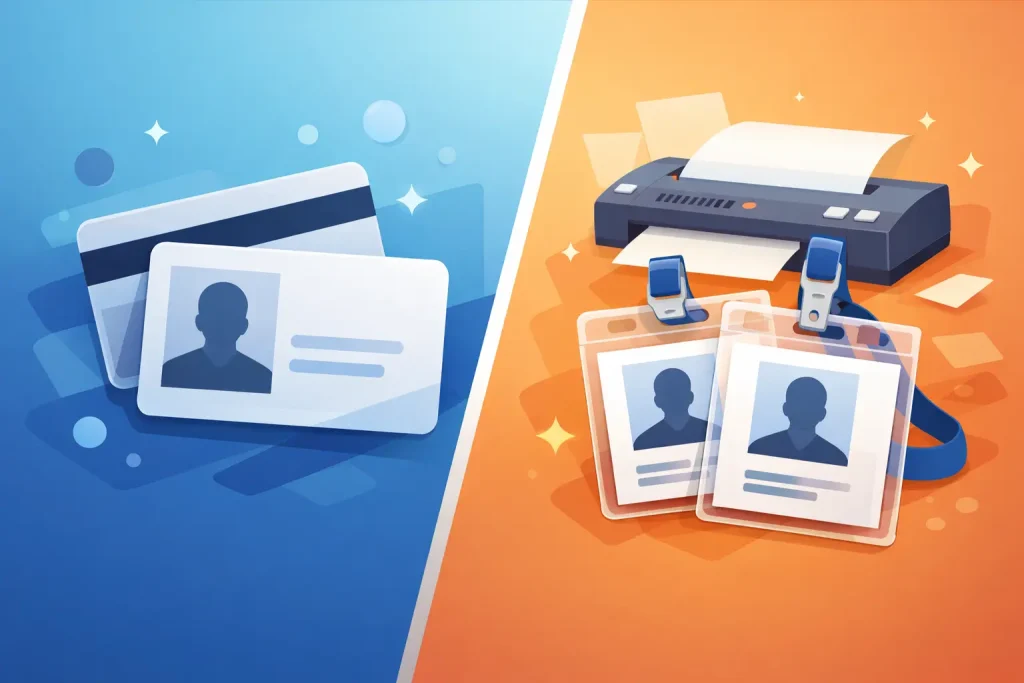
If you are ordering name badges or ID cards against a deadline, the wrong material choice creates problems fast. The question of PVC cards vs laminated paper badges usually comes down to four practical issues – durability, presentation, budget and how long the badge actually needs to last.
For some organisations, laminated paper is the sensible option. For others, it is a false economy that leads to reprints, scuffed branding and avoidable admin. The right answer depends on how the badges will be used, who will wear them and whether you need a short-run event solution or an ongoing identification system.
PVC cards vs laminated paper badges: what is the difference?
At a basic level, laminated paper badges are printed on paper or card stock and sealed in a laminate pouch or film. They are often used for conferences, school events, visitor passes and temporary staff identification. They are lightweight, low-cost and quick to produce.
PVC cards are manufactured from plastic and printed as a more permanent card format. They feel closer to a standard membership card or staff ID card. They are more rigid, more durable and generally better suited to repeated daily use.
That material difference affects nearly every buying decision. It changes how the badge looks in hand, how it wears over time, how well it handles moisture and friction, and whether it still represents your brand properly after a week, a month or a year.
When laminated paper badges make sense
If you are running a one-day or two-day event, laminated paper badges can be the most efficient choice. They do the job, they are cost-effective in volume and they are easy to personalise with names, roles or access levels.
For event planners and office teams, this matters. Not every badge needs to survive months of wear. If the badge is being issued at registration, worn for a limited period and discarded afterwards, paying for a premium material may not improve the outcome.
Laminated paper badges also work well when information changes often. If attendee names, departments or table allocations shift late in the process, a paper-based format gives you flexibility. For schools, conferences, community events and internal company functions, that can be more valuable than long-term durability.
There is a presentation trade-off, though. Laminated paper can still look clean and professional, but it does not have the same finished feel as PVC. Edges can curl, laminate can crease, and heavy handling tends to show quickly. If your badge is part of the first impression at a client-facing event, that difference is worth considering.
Where PVC cards justify the extra spend
PVC cards are the stronger option when badges are used repeatedly, issued long term or tied to security and brand consistency. Staff IDs, contractor cards, student cards, membership cards and venue access cards all sit in this category.
The main benefit is lifespan. PVC resists bending, moisture and surface wear far better than laminated paper. In practical terms, that means fewer damaged cards, fewer replacements and less time spent chasing reissues.
That matters even more when your card is paired with accessories such as lanyards, rigid holders, clips or reels. A card that is constantly tapped, swiped, clipped on and off, or carried every day needs to hold its shape. PVC does that reliably.
Print quality also tends to feel sharper and more permanent on a PVC card, especially when branding needs to stay consistent across multiple sites or departments. If your organisation has strict brand standards, or if card appearance reflects your professionalism to visitors, customers or staff, PVC usually delivers a better long-term result.
Cost is not just the unit price
Buyers often compare these products on the quoted per-unit cost alone, but that is only part of the equation. Laminated paper badges are cheaper upfront, which is why they are popular for short-term use. If your event has 500 attendees for one day, that lower entry cost may be exactly what you need.
But if badges are being worn daily, the replacement cycle changes the maths. A cheaper badge that needs reprinting after a few weeks can end up costing more than a durable card issued once and used for months or years.
There is also an admin cost. Replacing worn or damaged badges means new approvals, new print runs and more staff time. Procurement teams and office administrators usually feel that burden first. If you are trying to reduce internal effort, the more durable product can be the more efficient purchase even when the initial quote is higher.
Print finish, branding and professional appearance
A badge is a small product, but it carries a lot of visual weight. At events, in schools, at reception desks and on work sites, it often sits front and centre. People notice when it looks sharp, and they notice when it looks flimsy.
In the comparison of PVC cards vs laminated paper badges, PVC generally wins on presentation. It has a cleaner, more substantial feel and holds colour well over time. That is especially useful when you need exact brand colours across lanyards, cards and other event materials.
Laminated paper still has a place, particularly when the badge content is more important than the material finish. For example, a conference name badge with large readable text and a sponsor logo can perform perfectly well in laminated form. The question is whether the badge only needs to communicate, or whether it also needs to reinforce a polished brand standard.
Think about the environment the badge will face
Usage conditions matter more than many buyers expect. A badge worn in an air-conditioned conference venue has a relatively easy life. A badge used outdoors, on a school campus, in a warehouse or at a busy venue deals with heat, movement, moisture and constant handling.
Laminated paper can cope with light short-term use, but it is more vulnerable in rougher conditions. Once corners start to split or moisture gets in, the badge degrades quickly. PVC is simply more forgiving in demanding environments.
This is one of those areas where the cheapest option can become the risky option. If the badge has to remain readable and presentable throughout the full period of use, material strength matters.
How to choose the right option for your job
The easiest way to decide is to match the material to the purpose. If the badge is temporary, variable-data heavy and budget-sensitive, laminated paper is often the right call. If the badge is long-term, customer-facing or exposed to daily wear, PVC is usually the better investment.
It also helps to look at the full badge system rather than the card alone. A well-produced card paired with the right holder, lanyard or clip performs better and lasts longer. If you are ordering multiple items together, it is worth making sure the badge format suits the accessory setup and the way people will actually wear it.
For larger organisations, consistency matters as well. Different departments often order badges separately, which can lead to mixed finishes and uneven branding. Standardising on the right format from the start saves time later and creates a cleaner presentation across the business.
The practical decision for most buyers
There is no single winner in PVC cards vs laminated paper badges because the better product depends on the job. Laminated paper badges are efficient, affordable and well suited to short-term events. PVC cards cost more, but they earn that difference through strength, appearance and long-term value.
For procurement teams, marketing coordinators, school administrators and event organisers, the real question is not which product is better in theory. It is which one will perform properly without creating extra work. That is where a supplier with solid production guidance can make a real difference – especially when deadlines are tight, branding has to be exact and you need the order handled properly from artwork through to delivery.
If you are unsure, start with the lifespan of the badge. Once you know whether it needs to last a day or a year, the right material choice usually becomes clear.